Your Baby's Flat Feet Are Perfectly Normal — Here's Why
If you've ever looked at your baby's feet and thought, "Shouldn't there be an arch in there somewhere?" you're not alone. It's one of the most common concerns parents bring to their paediatrician or podiatrist, and the answer is almost always the same: there's nothing to worry about.
All typically developing babies are born with flat feet. It's not a defect or a warning sign; it's simply how human feet start out. Below, we explain the biological reason behind those adorably squishy flat feet, how arches develop over time, and what it all means when choosing your baby's first shoes.
The Real Reason Babies Look Flat-Footed: It's a Fat Pad
Here's something most people don't realise: your baby may already have the beginnings of an arch forming, but you simply can't see it. A thick, protective cushion of fat sits right over the arch area, hiding it completely. According to the American Academy of Pediatrics, this fat pad is a normal feature of infant feet and is the primary reason babies look so flat-footed.
There's another important factor at play. At birth, a baby's foot is made up mostly of cartilage rather than hardened bone. Those 22 tiny bones are still soft, cartilage-like structures that will gradually ossify (harden) throughout childhood. According to Straits Podiatry, this makes a baby's foot incredibly soft and pliable, which is exactly how it needs to be for healthy growth.
The arch itself, known as the medial longitudinal arch, doesn't begin developing until around age 3 and isn't fully formed until somewhere between age 8 and 10, as noted by Pediatric Foot & Ankle. That protective fat pad begins to naturally resorb once your child starts walking independently, which is why the arch becomes more visible as your toddler gets more active on their feet.
Those flat little feet aren't missing anything. They're simply at the very beginning of a long, gradual developmental journey.
When Do Baby Arches Actually Develop?
Arch formation is a slow, staged process. It generally starts becoming noticeable between ages 2 and 6, with most children showing a visible arch by age 6. According to UCSF Benioff Children's Hospitals, roughly 80% of children develop arches naturally, while about 20% carry flat feet into adulthood, and even then it's usually painless and perfectly functional.
It's also worth knowing that all toddlers under 16 months have flat feet. This is universal, not a red flag. As noted by Podiatrists, the arch only fully develops by age 6 to 8, and most children don't need special arch support in their shoes.
To put the pace of development in perspective: feet can grow up to 1.5mm per month between ages 1 and 3, roughly 18mm per year. Your baby's feet are actively developing every single day, even when it doesn't look like much is happening on the surface.
Flexible vs. Rigid Flat Feet: The Distinction Every Parent Should Know
Paediatric podiatry recognises two main types of flat feet in children, and understanding the difference can save you a lot of unnecessary worry.
Flexible flat foot is the overwhelmingly common type. If your child's arch appears when they stand on tiptoes or sit with their feet dangling, that's a flexible flat foot. According to the Children's Hospital of Philadelphia, this is considered a normal developmental stage, not a condition that needs treatment.
Rigid flat foot is far less common. In this case, the arch is absent in all positions, including sitting and tiptoeing. This is structural and does warrant a visit to a podiatrist or paediatrician for assessment. A 2026 clinical practice guideline published in Frontiers in Pediatrics represents the most current evidence-based consensus on when and how paediatric flat feet should be treated.
The key takeaway: flat feet only require treatment if the foot is stiff, painful, or rigid. Shoe inserts and orthotics do not create an arch and are not recommended for typical flexible flat feet in young children, as confirmed by the Pregnancy Birth and Baby resource. If your baby's feet are soft, flexible, and pain-free, you're in the normal zone.
What Flat Feet Actually Mean for Your Baby's Shoe Choices
Now that you know flat feet are a normal part of development, let's talk about what this means when you're standing in the shoe aisle (or scrolling online at midnight).
For pre-walkers: Babies who aren't yet walking independently don't need structured shoes at all. At this stage, footwear is for warmth and protection only. Rigid shoes can actually interfere with natural foot development when feet are at their most adaptable.
For early walkers: Paediatric physiotherapists and podiatrists recommend flexible, lightweight shoes with a wide toe box, a thin sole, and zero or minimal heel drop. According to The Movement Mama Blog, these features allow for sensory feedback (proprioception) and natural muscle development.
Why does sensory feedback matter? Thin, flexible soles help babies feel the ground beneath them. This tactile information is critical for balance, coordination, and the muscle activity that supports arch development over time.
The research backs this up. A 2022 study published in PLOS One found that toddlers who habitually wore barefoot-style shoes showed a higher plantar arch and a better foot progression angle after just 7 months of independent walking, compared to those in conventional shoes.
What to avoid: Rigid soles that restrict natural foot movement. Built-in arch supports that can interfere with muscle development. Elevated heels that shift weight distribution unnaturally. Non-breathable synthetic materials that trap moisture against soft, developing skin. Each of these works against what a growing foot actually needs.
Barefoot Time at Home vs. Shoes Outside: Getting the Balance Right
Barefoot time indoors isn't just okay; it's actively beneficial. Walking on varied surfaces stimulates the small intrinsic muscles of the foot and supports natural arch development. A multicenter study published in Scientific Reports found that children who regularly go barefoot have a comparatively higher medial longitudinal arch than those who habitually wear conventional footwear.
Shoes are appropriate for outdoor protection, cold surfaces, and rough terrain, but they should mimic barefoot conditions as closely as possible. A 2024 systematic review confirmed that up to 6 months, babies don't need shoes at all, and between 6 months and 3 to 4 years, flexibility of footwear is essential.
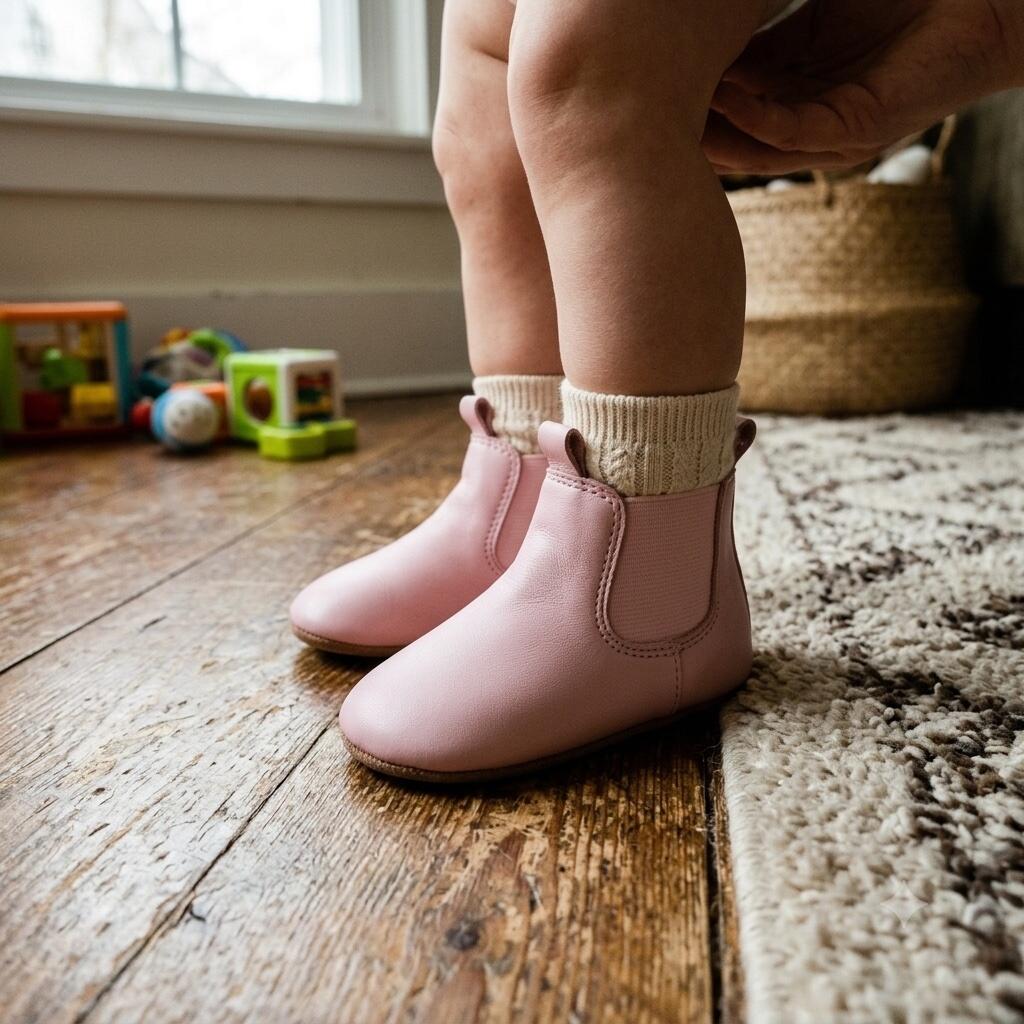
Our practical tip: let babies and toddlers go barefoot on safe indoor surfaces as much as possible, and choose barefoot-style shoes when footwear is needed. Breathable materials like genuine leather allow airflow and move naturally with the foot, which is especially important for feet that are mostly cartilage and growing rapidly.
A Simple Guide to Choosing the Right Shoes at Each Stage
Rather than thinking about shoes by age alone, it helps to match footwear to your baby's developmental stage.
-
Pre-crawling and crawling: Soft, flexible booties or pre-walker shoes for warmth and protection. No rigid sole needed. Think of these as cosy covers, not structural supports.
-
Cruising and early walking: A thin, flexible sole that lets little feet feel the ground. A wide toe box to accommodate chubby baby toes. Zero heel drop. Lightweight construction. Soft, natural materials like leather that move with the foot.
-
Confident walkers: A slightly more durable sole for outdoor surfaces, but still flexible, lightweight, and wide in the toe box. The shoe should bend where the foot bends, not where the shoe decides.
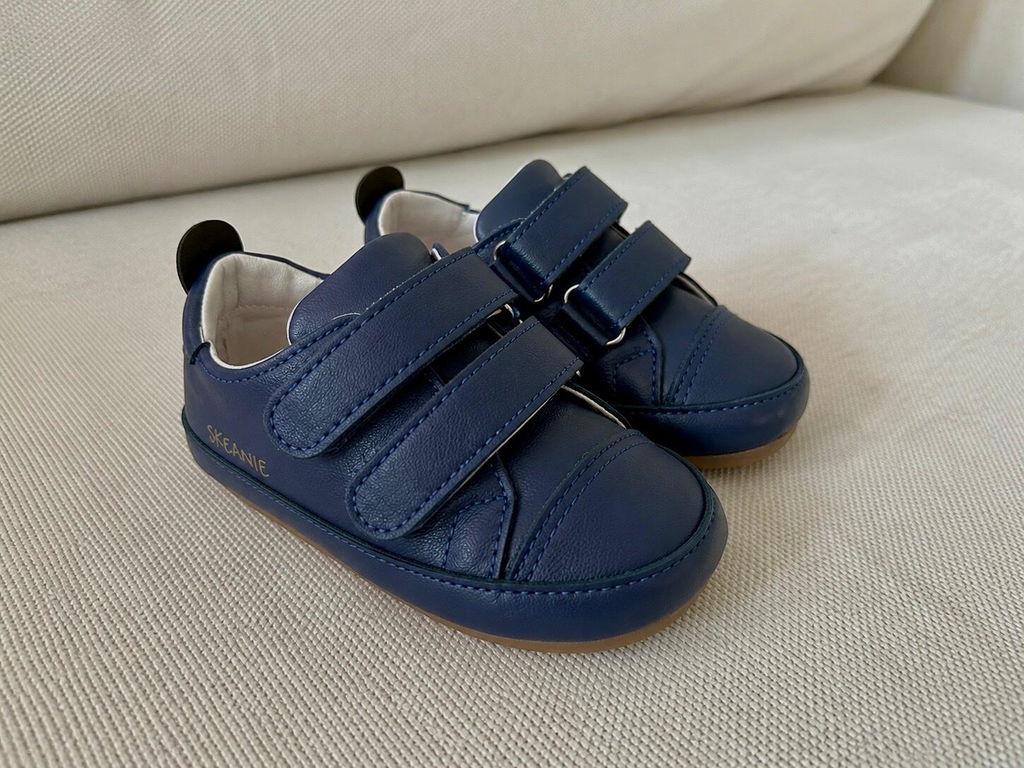
At SKEANIE, we've designed our collections around exactly these developmental principles since our founding in 2005. Our stage-specific shoes are podiatry approved, giving parents confidence that the design genuinely supports healthy foot development.
One more thing to keep in mind: between ages 1 and 3, feet can grow up to 18mm per year. Fit checks every 6 to 8 weeks matter, not just at the time of purchase. And if you're buying baby shoes as a gift, prioritise flexibility and natural materials over style or structure.
The Bottom Line: Flat Feet Are a Feature, Not a Flaw
Flat feet in babies and toddlers are biologically normal, universally present at birth, and resolve naturally for the vast majority of children. A systematic review in the Journal of Foot and Ankle Research confirmed that flat foot prevalence consistently decreases with age, reflecting this natural developmental resolution.
The best thing you can do as a parent is choose flexible, wide, breathable shoes that get out of the way of natural development, and allow plenty of barefoot time at home. No special inserts. No corrective footwear. Just space to grow.
If your child's foot is rigid or painful, or if they're limping or avoiding walking, a visit to a podiatrist is absolutely worthwhile. But flat feet on their own? Not a reason for concern.
Your baby's feet are doing exactly what they're supposed to do. Your job is simply to give them the space, and the right shoes, to grow into the strong, healthy feet they're meant to be.
Sources