Why Baby Shoe Sizing Confuses Almost Every Parent
Here's a statistic that stops most parents in their tracks: 67% of children are wearing shoes that are too small. According to a BlitzResults survey of more than 2,000 parents, 48% of kids are in shoes one size too small and 19% are two sizes too small. Only 33% of children wear the correct size, and just 10% of those have adequate room to grow.
The core of the problem? A single toddler foot measuring 14.6cm corresponds to US size 8C, UK/AU size 7, and EU size 24. Three completely different numbers for the exact same foot. Most parents assume shoe sizing is standardised globally, like clothing labels. It isn't.
Let's break down each system clearly, explain why they differ, and give you the confidence to size your little one's shoes correctly every time.
The Four Main Sizing Systems, and Where Australia Fits
If you've ever wondered why Australian baby shoe sizes seem identical to UK sizes, there's a simple reason: Australia follows the UK children's shoe sizing system. An AU size equals a UK size exactly. According to Mouths of Mums, there is no single mandatory Australian standard, which means brand-to-brand variation exists, but the baseline system mirrors the UK.
The UK system has a quirky origin. It's historically based on the "barleycorn" unit (one-third of an inch), which is why sizes don't translate neatly into metric measurements. It's an old system, and it shows.
The US system runs approximately one size larger than UK/AU. So a UK/AU size 7 equals a US size 8. This is a consistent offset that's easy to remember once you know it, as noted by Daisy Chain Clothing.
European sizes use the Paris Point system, based on foot length in centimetres. It's an entirely different mathematical origin, which is why conversion charts are always needed. EU sizes also don't use half sizes, meaning converting a UK/AU half size to EU requires rounding, and the result can be slightly too small or too large. Shoe Size Guide Australia provides helpful conversion tables for this reason.
In Japan and parts of Asia, children's shoe sizes are measured directly in millimetres. A 145mm foot equals Japanese size 145. It's arguably the most intuitive system of all.
The important takeaway? There is no mandatory global shoe sizing standard. Brands can and do deviate, which is why your child may wear different sizes across different brands, even within Australia. According to Consumer Affairs, this inconsistency is widespread and well-documented.
The US Size Reset: A Specific Trap for Online Shoppers
Here's one that catches Australian parents off guard when shopping US brands online. In the US system, toddler and little kid sizes run from 0 to 13. Then "big kid" sizes restart at 1, meaning a size 1 big kid shoe is the next size up from a size 13 toddler shoe. According to REI, this reset is a common source of ordering errors.
Some brands label toddler sizes with a "T" (e.g., 4T, 5T) to distinguish them from big kid sizes, but as Carter's notes, this convention is not universal. If you're shopping US brands on Amazon, ASOS, or global brand websites, always check whether a US size is listed as toddler or big kid before purchasing. It's a small detail that prevents a big headache.
How Fast Do Baby Feet Actually Grow?
Baby feet grow at a pace that surprises most parents. In the first 15 months of life, babies' feet grow approximately half a shoe size every two months, according to Guildford Podiatry Centre. That means a baby can go through more than seven sizes before their second birthday. In the first year alone, infants can go through approximately four shoe sizes.
A PubMed-published study on foot growth rates found that children aged 12 to 30 months need a shoe size change every 2 to 3 months. This slows to every 4 months up to age 4, and every 6 months from ages 4 to 6.
To put it in millimetres: between ages 1 and 3, feet grow approximately 1.5mm per month (about 18mm per year). Between ages 3 and 6, this slows to approximately 1mm per month, as detailed by Softstar Shoes.
Here's the part that concerns us most: 52% of parents surveyed said they had never measured their child's foot length, relying solely on visual and sensory tests to judge fit. And here's why that's risky: children cannot reliably tell you their shoes are too tight. Nerve development in young feet is not fully mature, meaning kids genuinely may not feel discomfort from a too-small shoe.
The practical takeaway is simple: measure, don't guess, and measure regularly.
Why Sizing by Age Is the Least Reliable Method
Age-based size charts are everywhere. They're also the least accurate method for finding the right fit. Two toddlers the same age can easily wear shoes two or three sizes apart due to natural variation in foot growth rates. Foot measurement always trumps age; developmental stage is the next most useful guide.
It helps to understand what's happening inside those tiny feet. Babies are born with flat feet. Arches typically begin to develop visibly around ages 2 to 3, and according to a 2025 PMC rapid scoping review, foot bones do not fully ossify until ages 14 to 18.
This is why we think about footwear in terms of developmental stages: pre-crawling, crawling, cruising, and first steps. Each stage has different footwear needs beyond just size. A 2023 systematic review published in PMC found that flexible, soft-soled shoes produce outcomes closer to barefoot walking, which supports healthy foot muscle development in early walkers. The right shoe type matters just as much as the right shoe size.
The Gifting Problem: Buying Baby Shoes for Someone Else
Baby shoes are one of the most popular newborn and baby shower gifts. They're also one of the trickiest to get right. Cross-system sizing confusion makes gifting a genuine minefield, especially when shopping internationally or from overseas brands.
Sizing by age is especially unreliable as a gift strategy. As we mentioned, two babies the same age can differ by two or three sizes. Our practical advice for gift-givers: ask the parent for the child's current foot length in centimetres or millimetres, not their age or current size in another brand.
If you can't get a measurement, gifting a size up is generally safer than gifting the current size. Babies grow quickly, and a slightly larger shoe is more forgiving than one that's already too small.
According to a Decent Foot survey, 70% of parents have experienced sizing disparities across different shoe brands. Brand-to-brand variation is real and normal, so don't feel bad if a size doesn't match expectations.
One less thing to worry about: baby shoe sizes are gender-neutral in Australia, the EU, and the US. There's no difference between a boy's and a girl's size in children's footwear. You're already doing a lovely thing by choosing a thoughtful gift; a little sizing homework makes it even better.
Width Matters Too, and Most Sizing Guides Ignore It
Most baby shoe sizing guides focus only on length. But foot width is equally important for healthy development. Many babies have characteristically wide, chubby feet that standard length-based sizing simply does not accommodate.
A shoe that fits in length but is too narrow can restrict natural toe splay and impede healthy foot development. A 2009 study cited by My FootDr Australia found that over 88% of 808 children studied wore shoes that weren't long enough, and identified a significant relationship between poorly fitting footwear and the development of bunions (hallux valgus). Related research found that almost 30% of children had irreversible foot deformities such as hallux valgus.
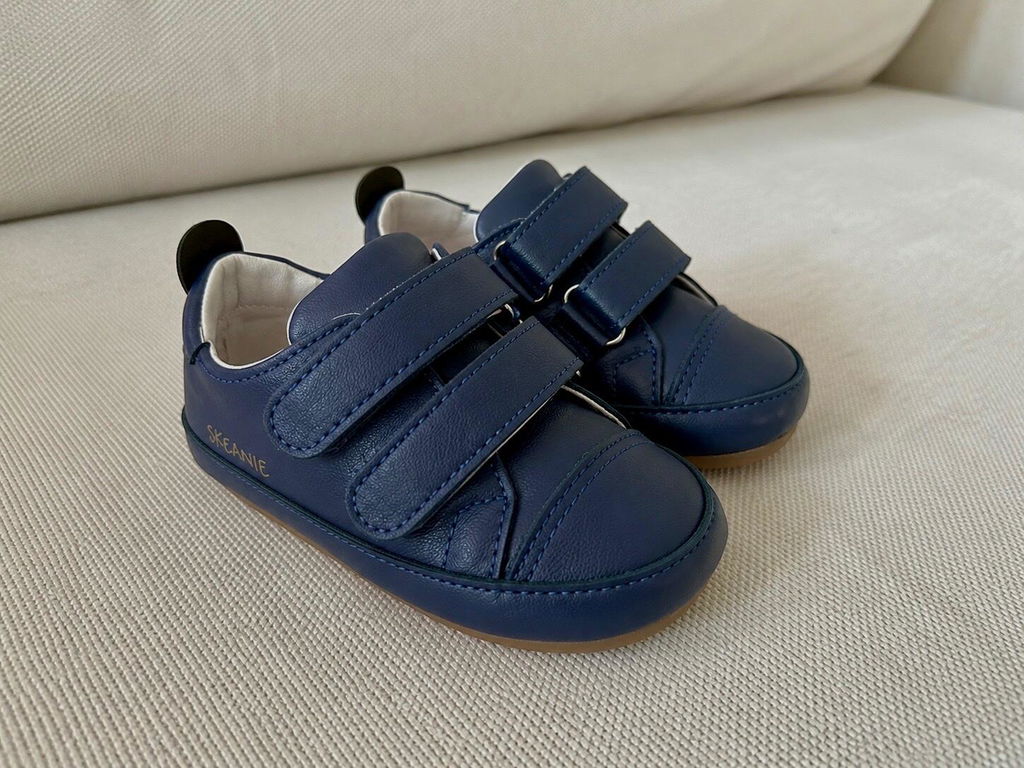
These statistics underscore why fit across both dimensions matters. Look for shoes with a wide toe box designed to accommodate natural foot shape, especially for pre-walkers and early walkers. At SKEANIE, our shoes are specifically designed with a wide toe box to give chubby baby toes the room they need, because healthy development starts with space to move.
How to Measure Your Baby's Feet at Home
Getting an accurate measurement at home is simpler than you might think. Here's how:
- Place your baby's foot flat on a piece of paper (standing if they can, or gently pressing the foot flat if they can't yet).
- Trace the outline of the foot with a pen held vertically.
- Measure from the heel to the tip of the longest toe in centimetres or millimetres.
Always measure both feet. Feet are often slightly different sizes; fit to the larger foot. Measure at the end of the day when feet are at their largest.
When selecting a size, add approximately 10 to 12mm (about 1cm) of growing room to the measured length. This is the standard podiatric recommendation for children's footwear.
Use the foot length in centimetres/millimetres as your anchor when converting across AU, US, UK, and EU systems. It's the one universal reference point that works across all sizing systems. Even with accurate measurement, brand-to-brand variation means it's worth checking a specific brand's own size chart rather than relying on generic conversion tables.
A survey found that 70% of parents prefer stores that offer professional shoe fitting. For online shoppers, a detailed brand size chart with centimetre measurements is the next best thing.
Sizing Smarter: What to Remember
Always convert using centimetre/millimetre foot length as your starting point.
There is no mandatory global sizing standard. Brand variation is real, and checking each brand's own chart is always the safest approach. Children's feet grow rapidly, so shoes should be checked and replaced regularly, not just when a child complains (because they often can't feel the problem).
Shoe type matters as much as size. Barefoot-designed, flexible, soft-soled shoes support healthy development at every stage. SKEANIE's stage-specific collections are designed with these principles in mind. You can find our detailed size guide on our website to help you find the perfect fit.
Getting sizing right is one of the most meaningful things you can do for your child's long-term foot health. And once you understand the system, it really doesn't have to be complicated. You've got this.
Sources