Your Baby's Secret Sixth Sense - and why it starts in their feet
You know about sight, hearing, touch, taste, and smell. But there is a sixth sense quietly shaping your baby's development right now, and most parents have never heard of it. It is called proprioception: the body's ability to perceive its own position, movement, and force in space.
Unlike the five familiar senses, proprioception works behind the scenes. You cannot see it, but it profoundly influences how your little one learns to balance, move, and explore their world.
Here is something remarkable: the sole of your baby's foot contains approximately 200,000 nerve endings, making it one of the most sensory-rich areas of the entire body. So what happens to a toddler's developing brain when those nerve endings are muffled by thick, rigid shoes? Let's explore.
How Ground Feel Travels from Tiny Feet to the Developing Brain
Your baby's foot soles are not just for standing on. They are sophisticated sensory organs, equipped with four distinct types of receptors that feed information directly to the brain.
According to research published in the Journal of Neurophysiology, these four classes of cutaneous mechanoreceptors each play a unique role:
-
Meissner's corpuscles detect light touch and texture, helping your baby sense the difference between carpet and tiles.
-
Pacinian corpuscles respond to vibration and deep pressure, registering the impact of each little step.
-
Ruffini endings pick up sustained pressure and skin stretch, providing feedback about foot position.
-
Merkel's disks detect fine spatial detail and edges, like the feel of a step's edge underfoot.
Together, these receptors transmit a constant stream of tactile and proprioceptive signals to the central nervous system. A 2025 study in Scientific Reports confirmed that the brain must continuously integrate proprioceptive, visual, and vestibular input to generate corrective motor commands for postural control. In young children, this integration process is still maturing, which is why toddlers wobble and stumble as they learn.
With roughly 90% of brain development occurring in the first six years of life, early sensory input is especially powerful. Every moment your toddler feels grass between their toes, gravel underfoot, or a cool wooden floor is a moment they are actively building neural pathways. These are not just cute milestones; they are brain-building experiences.
The Critical Window: Why the First Four Years Matter Most
Your baby's feet are not simply miniature adult feet. At six months of age, a baby's foot is still mostly cartilage. The last bone does not begin to form until around age three, and by age four, the foot's shape, muscle tone, and arch development have solidified significantly. This makes those early years a truly formative window, both structurally and neurologically.
Research published in IOPscience identifies the preschool years (ages 3 to 7) as the optimal period for developing coordination, balance, proprioception, and spatial orientation. The nervous system's plasticity is at its greatest during this time, meaning children's brains are primed to absorb and respond to sensory input from their feet.
The science backs this up with real numbers. The 2025 Scientific Reports study confirmed that proprioceptive acuity directly contributes to children's dynamic postural control, with higher proprioceptive error linked to poorer balance. A 12-week study of children aged 3 to 6 found that those who received proprioceptive and balance training showed statistically significant improvements in both static and dynamic balance (p<0.01).
This is not about putting pressure on your child to hit milestones faster. It is about understanding that there is a naturally open window for sensory development, and creating rich, tactile environments during this period gives your little one the best foundation.
From Wobbly Steps to Steady Confidence: The Proprioception–Self-Esteem Chain
Here is something that might surprise you: the benefits of strong proprioception extend far beyond physical balance. There is a well-documented chain connecting ground feel to your child's emotional wellbeing.
It works like this: proprioceptive input leads to improved balance, which builds stronger motor competence, which in turn fosters higher self-esteem and confidence. Research published in ScienceDirect shows that motor competence predicts self-esteem in children, with poor motor ability linked to social withdrawal.
A 2024 study took this further, finding a significant correlation between proprioceptive deficits and emotional difficulties in children. Proprioception, it turns out, is relevant not just to physical balance but to mood and self-regulation too.
It is also worth noting that Developmental Coordination Disorder (DCD), closely linked to proprioceptive deficits, affects an estimated 5 to 8% of school-age children and is associated with lower self-esteem and social maladjustment.
The warm takeaway? A toddler who feels steady underfoot is more willing to explore, take risks, and develop independence. Those wobbly first steps are not just physical; they are building the emotional courage your child will carry with them.
What Conventional Shoes Actually Do to Sensory Feedback
As parents, our instinct is to protect those tiny feet. That instinct is beautiful and valid. But it is worth understanding what thick, rigid soles actually do to your child's sensory experience.
Rather than simply protecting, conventional shoes act as sensory insulators. Research published in Gait & Posture found that conventional shoes reduce first metatarsophalangeal joint range of motion from 36.0° barefoot to just 10.7° shod, and midfoot sagittal motion drops from 22.5° to just 6.2°. That is a dramatic reduction in the natural movement essential for sensory feedback.
A PLOS One study of 30 toddlers showed that after seven months, those wearing barefoot-style shoes had a statistically significantly higher plantar arch and a smaller foot progression angle compared to those in conventional shoes. A 2025 systematic review published in MDPI Applied Sciences, covering 22 studies, found that children in barefoot-style shoes show superior postural control and dynamic stability.
True protection for developing feet means keeping that vital conversation between feet and brain wide open.
Barefoot When You Can, Barefoot-Designed When You Can't
The Victoria State Government's Better Health Channel puts it simply: toddlers should go barefoot as often as possible to encourage balance, posture, and coordination. At home and on safe natural surfaces, bare feet are ideal.
But we live in the real world. There are hot pavements, sharp objects, childcare drop-offs, and family outings. When shoes are needed, the goal is to choose footwear that preserves as much ground feel as possible. Here is what to look for:
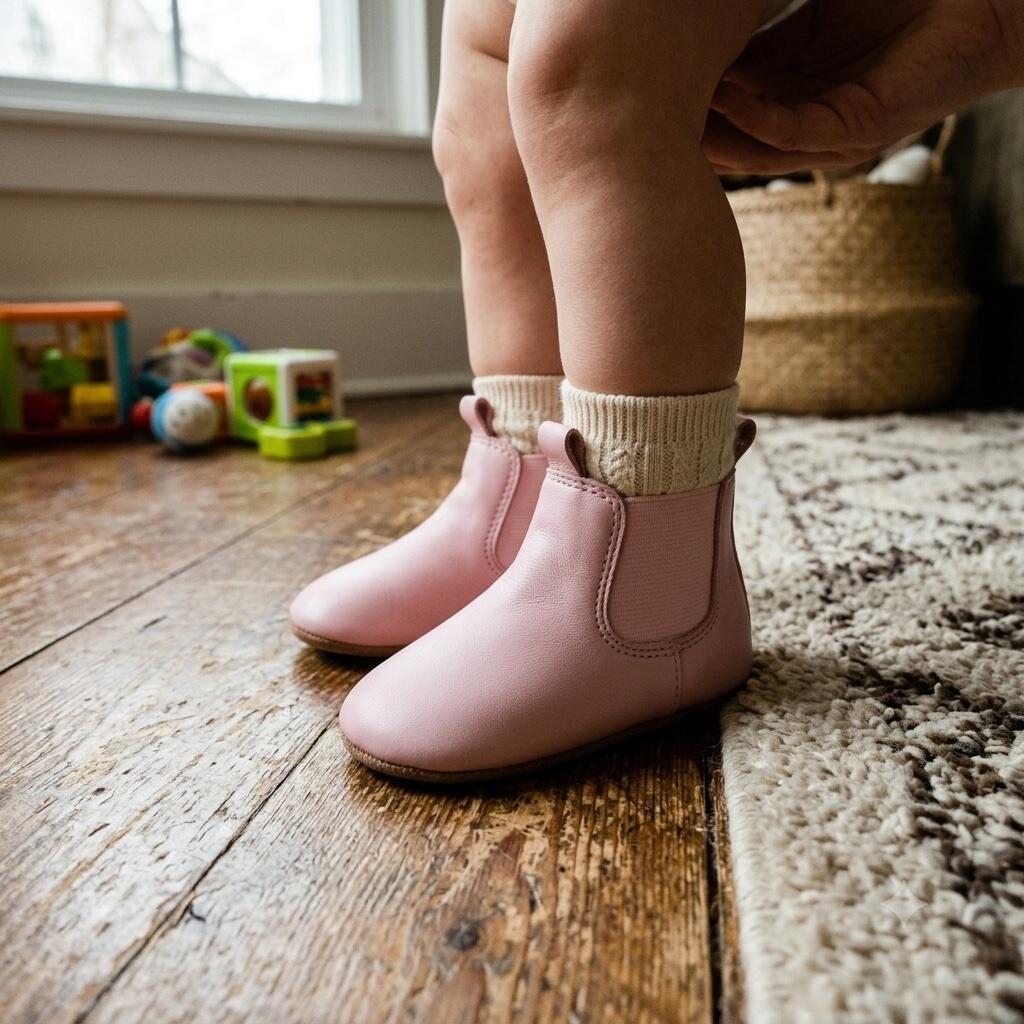
- A thin, flexible sole that transmits ground feel rather than blocking it
- A wide toe box that accommodates natural toe splay
- Soft, natural materials that move with the foot
- Podiatry approval from a recognised authority
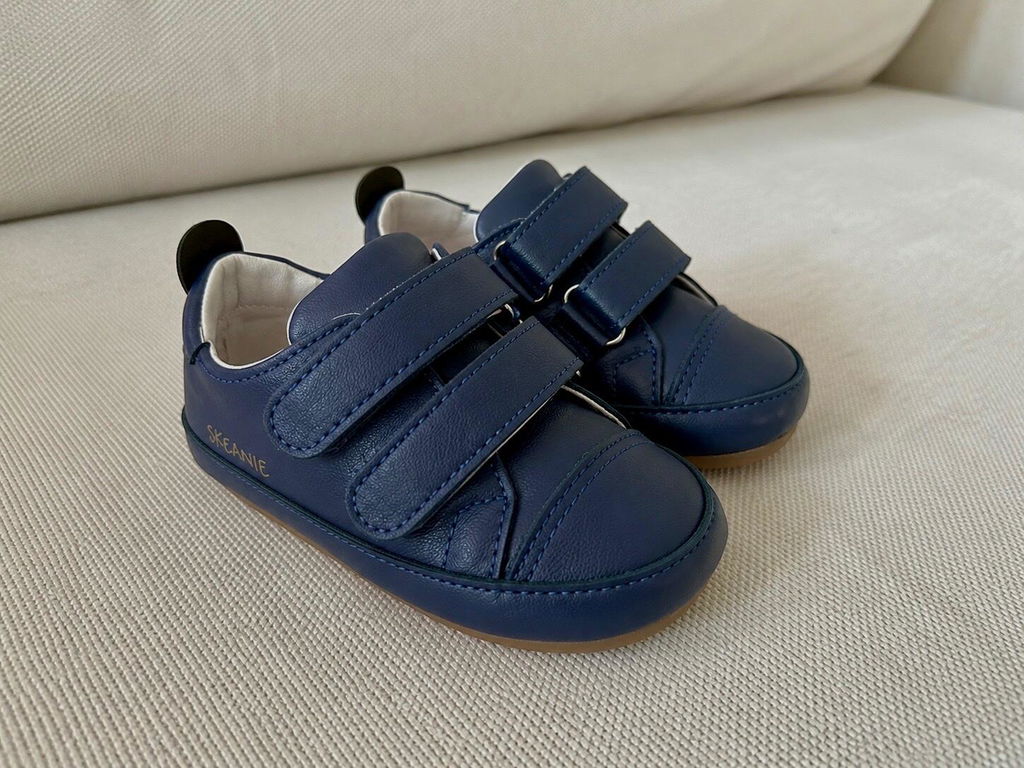
This is exactly the philosophy behind what we do at SKEANIE. Our shoes are barefoot-inspired, made from genuine soft leather, and designed with a wide toe box to give little toes room to spread. Our stage-specific collections are designed to match your baby's developmental milestones, from pre-crawling through to confident walking.
The goal is not perfection. Every barefoot moment counts, and every ground-feel-friendly shoe choice adds up.
Give Their Feet Room to Listen
Proprioception is one of the most foundational senses your child has, and their feet are its primary antenna during the toddler years. From ground feel to balance, from motor competence to self-esteem, the chain of benefits starts with what those 200,000 nerve endings are allowed to experience.
The simplest thing you can do? Let little feet feel the world as often as possible. When shoes are needed, choose ones that keep the conversation between feet and brain wide open.
As a mum who started SKEANIE because I wanted better for my own children's feet, I know the science can feel overwhelming. But it really comes down to something beautifully simple: trust your child's feet to do what they were designed to do, and give them the freedom to do it. You are already doing a wonderful job.
Sources